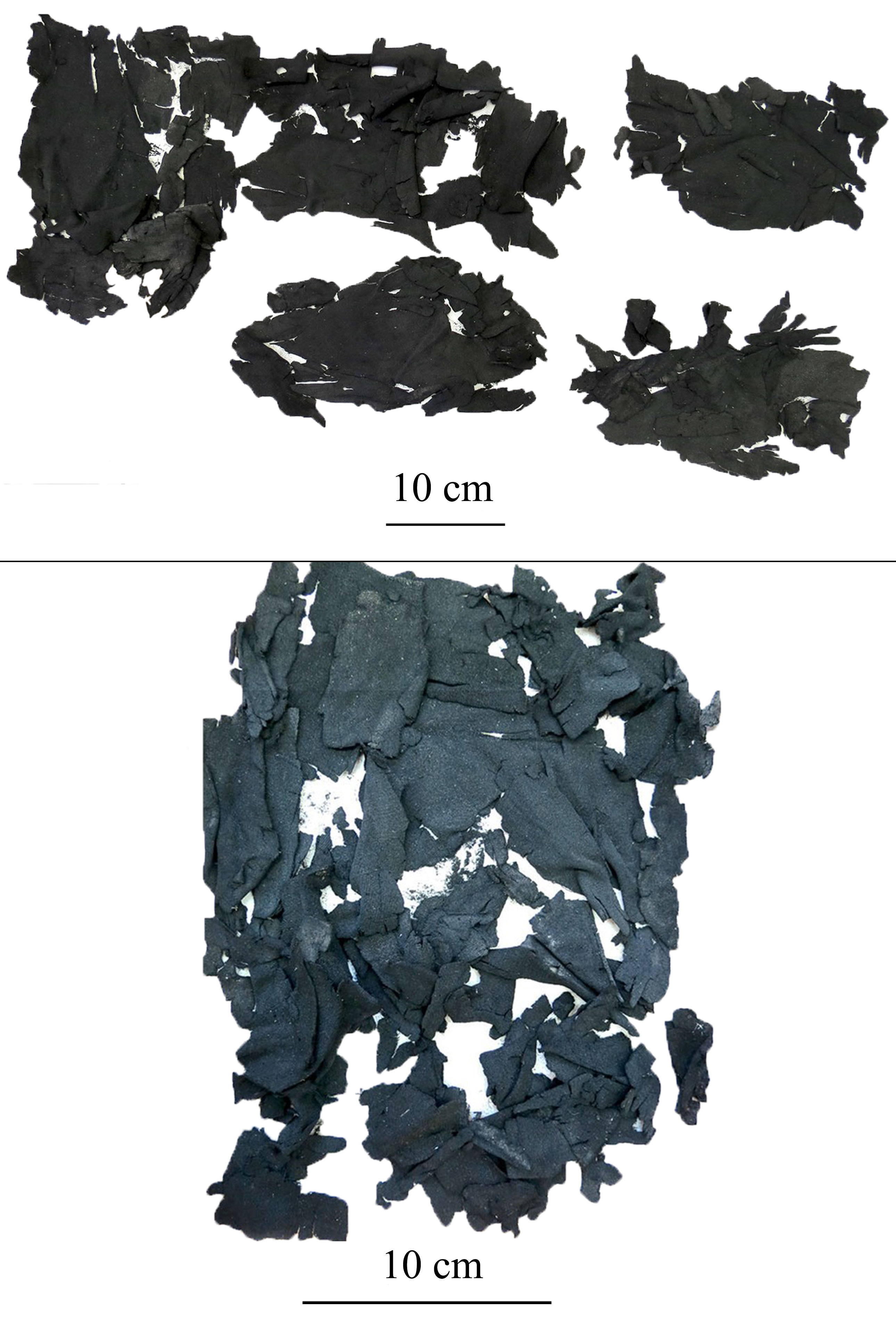
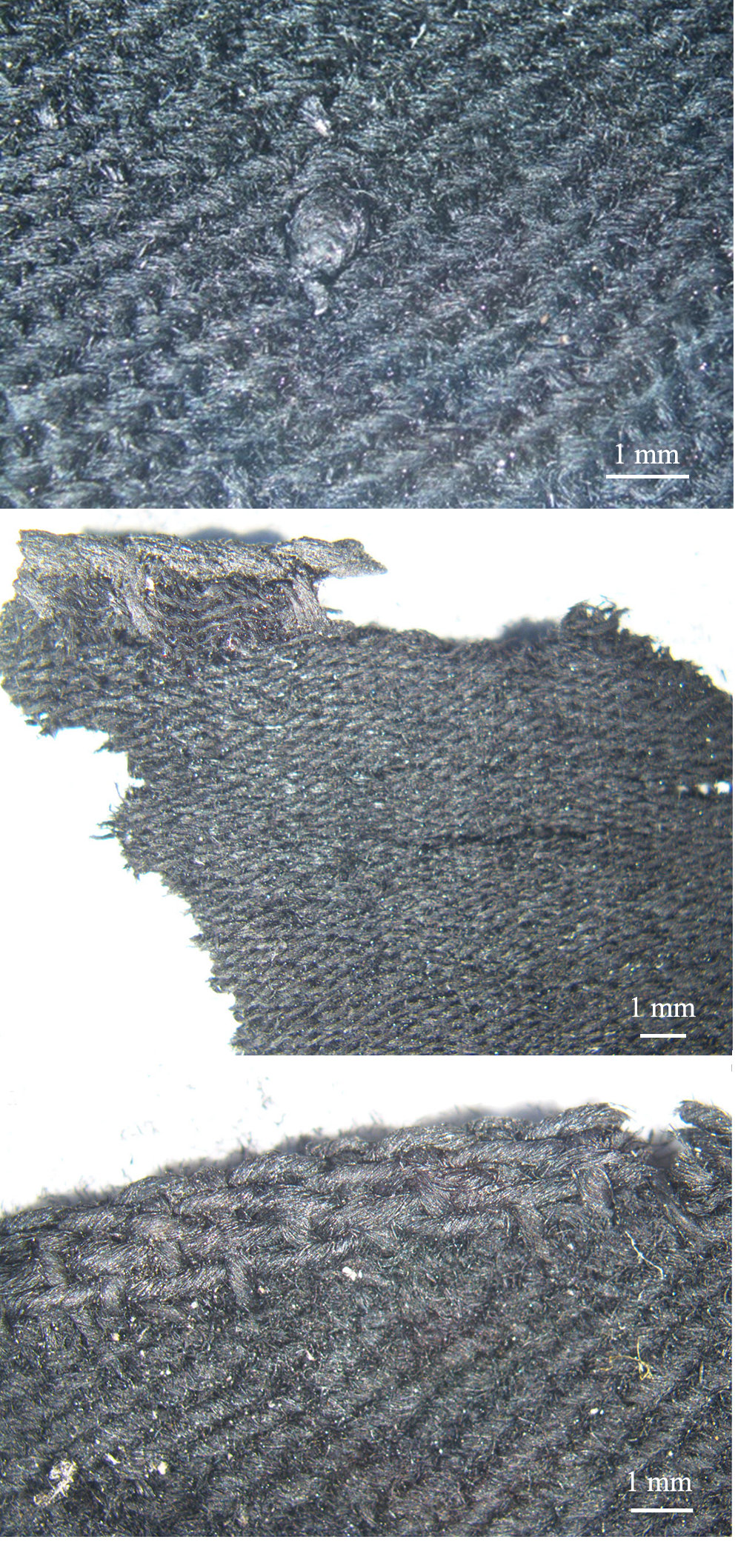
Pompeii 18061 (type 21-22) 2/2 weft-faced twill (tight)
Catalogue number
Ts 227
Inventory number
18061
Holding institution
Archaeological Park of Pompeii
Description
Semicircular cloak.
83 fragments. Max. dimension 33 x 32 cm; Min. dimension 1 x 0,5 cm.
The threads are smooth, and the fibres lie parallel within the threads.
Context
Basic information
Object condition
fragmentary
Preservation state
carbonised
Object type
cloak
Fabric structure
2/2 weft-faced twill
Warp and weft identified
✓
| System 1 | System 2 | Warp 2 | Suppl. yarn | |
|---|---|---|---|---|
| Material | wool | wool | ||
| Fibre identification method | SEM | SEM | ||
| Colour | ||||
| Yarn structure | plied | single | ||
| Twist strength | ||||
| Twist | S2z | z | ||
| Twist angle average | ||||
| Twist angle range | 37 - 44 | 26 - 27 | ||
| Diameter average | ||||
| Diameter range | 0.2 | 0.2 | ||
| Thread count average | ||||
| Thread count range | 28 - 30 | 62 |
FURTHER DETAILS
Pattern
tapestry
Pattern element
band
Borders
Three additional fragments preserve part of the original border of the textile (0.85 cm), plausibly corresponding to the upper, straight margin of the hood. The edge consists of a braid formed by two supplementary threads serving both decorative and functional purposes.
Edges
Needlework edging: the edging resembles a narrow tape in tabby weave on the obverse face of the fragment, with closely spaced, large plain overcast stitches perpendicular to the edge on the reverse face; 9 continuous 'warp' elements are running parallel to the edge, 3 threads running along reverse side of edge, 2 thread along the cross section and 4 threads along the obverse side of edge; These elements are intersected orthogonally by more widely spaced threads, following a 1:1 tabby weave ratio, which are clearly visible on the reverse of the textile.
Only one fragment (2 × 3 cm) shows part of a corded edge (Z-wisted) newly applied to the fabric by sewing. The edge runs parallel to the weft system and was most likely positioned along one of the upper, straight margins of the garment.
Fleece analysis
The yarns used for the reconstruction of the edges show fibres that are more degraded than those used for the main structure.
The fabric shows fibres with a surface morphology characterised by prominent scales and smooth edges, arranged in a mosaic-like pattern. The fibres have an average diameter of 17 μm (min. 11 – max. 28 μm).
Quality: AAA+, 98% < 25 µm (Classification method: Rast-Eicher 2008, Coletti 2025, p. 60).
Sewing
Description
The textile shows needle-worked edges and areas where mending and reinforcement interventions can be identified. Numerous holes left by sewing threads are visible across the textile surface. Traces of mending carried out using a technique comparable to the “couching stitch” are documented on four fragments. This method consists of threads laid on the textile surface and secured by short intersecting stitches passing beneath two weft threads. The yarn is clearly visible on only one side of the fabric, where its sinuous, “serpentine” course can be observed. The threads applied in this manner are fixed with knots, occasionally identifiable among the dense weft threads.
The fragments are in extremely poor condition, making it difficult to reconstruct the original pattern of thread insertion in the fabric.
Repair
✓
Types of stitch
overcast stitch
,
couching
Sewing yarn fibre
wool
Sewing yarn structure
plied
Sewing yarn twist direction
S2z
Sewing yarn min diameter
0.4
-
0.5
Sewing yarn 2 fibre
wool
Sewing yarn 2 structure
single
Sewing yarn 2 twist direction
z
Sewing yarn 2 diameter
0.3
References
Coletti, Francesca. I tessuti di Pompei e d’Area Vesuviana. A3TEX Series, I. Roma: Edizioni Quasar, 2025.
Data recorded by
Francesca Coletti
Data entered by
Francesca Coletti
Date of study
2019