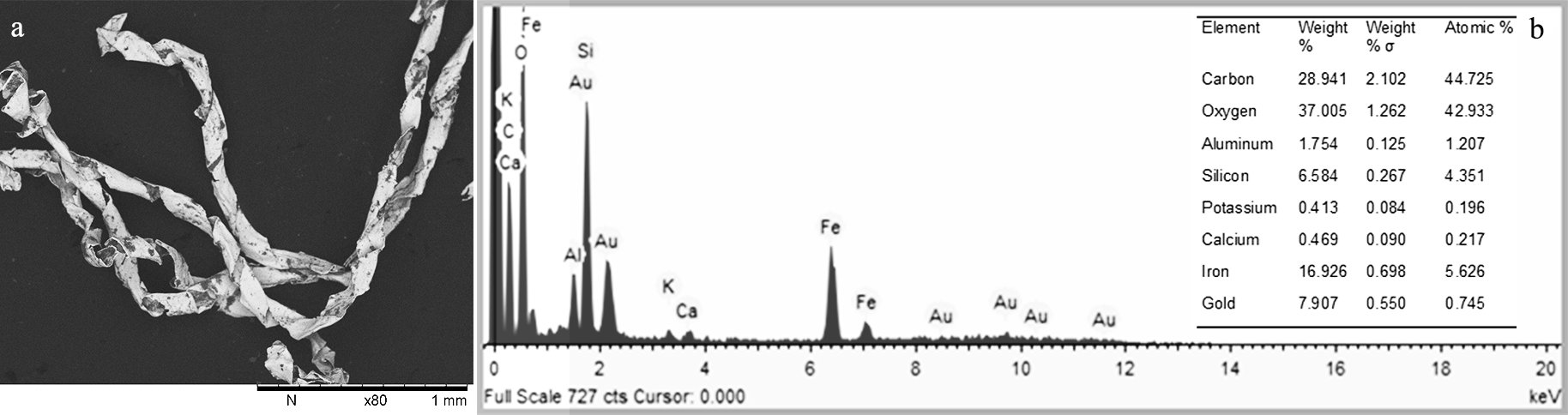
Pompeii 12446 (type 2) Gold ribbon
Catalogue number
Or 7
Inventory number
12446
Holding institution
Archaeological Park of Pompeii
Description
On the fragment, there are small circular holes near the longitudinal selvedges, probably caused by the passage of a sewing thread to secure the band to the garment.
Gold threads:
filé couvert (z-twist)
30-35 twists per cm
Strip width: 200 μm
Strip thickness: 1-2 μm
Strip cutting method: push-down blade
Core raw material: unidentifiable
Context
Basic information
Dimensions
L.
28
mm
W.
2
mm
Object condition
incomplete
Object type
gold ribbon
Fabric structure
4/4 basket weave
Warp and weft identified
✓
| System 1 | System 2 | Warp 2 | Suppl. yarn | |
|---|---|---|---|---|
| Material | gold | gold | ||
| Fibre identification method | SEM | SEM | ||
| Colour | ||||
| Yarn structure | ||||
| Twist strength | ||||
| Twist | ||||
| Twist angle average | ||||
| Twist angle range | ||||
| Diameter average | ||||
| Diameter range | 0.1 | - 0.1 | ||
| Thread count average | ||||
| Thread count range | 160 | 32 |
FURTHER DETAILS
Selvedge type
simple
Other features
SEM: amorphous residues of organic material attributable to the internal core were documented.
SEM-EDX: Au
SEM–EDX, FTIR: The identification of iron, silicon, calcium, and aluminium documents the presence of clay, most likely used together with binding substances to fix the strips to the organic fibres and to prevent damage to the internal core. Finally, the evident copper-like tone can be attributed to the presence of iron oxides, which, when present in large quantities, give the gold a warmer colour temperature.
RAMAN: the analyses more precisely detected the presence of hematite, the α allotrope of iron oxide (Fe₂O₃), a component of ochres and earth pigments, and also characteristic of clayey materials such as bole.
References
Coletti, Francesca. I tessuti di Pompei e d’Area Vesuviana. A3TEX Series, I. Roma: Edizioni Quasar, 2025.
Galli, M., F. Coltti, A. Ciccola, and I. Srafini. “Archeologia e Archeometria Del Tessuto Antico: Un Gruppo Di Manufatti Aurei Dall’area Vesuviana (Pompei, Ercolano, Oplontis).” Scienze Dell’Antichità, no. 26.1 (2020): 205–23.
Galli, M., F. Coltti, and S. Mitschke. “Textile Culture at Pompeii” Project.” In Textiles, and Dyes in the Mediterranean Economy and Society. International Symposium on Textiles and Dyes in Th Ancient Mediterranean World, edited by M Gleba, M. S. Busana, and F. Meo, 275–93. Purpureae Vestes 6. Zaragoza: Libros Pórticos, 2018.
Data recorded by
Francesca Coletti
Data entered by
Francesca Coletti